
Develop edge AI
at software speed.
Ghostlayer predicts how your model will perform on the target SoC, latency vs. accuracy tradeoffs, at design time, before it's ever trained, quantized, or flashed to hardware. From the full model down to each layer and operator, inside the workflow you already use.
Built by and for algorithm and embedded engineers
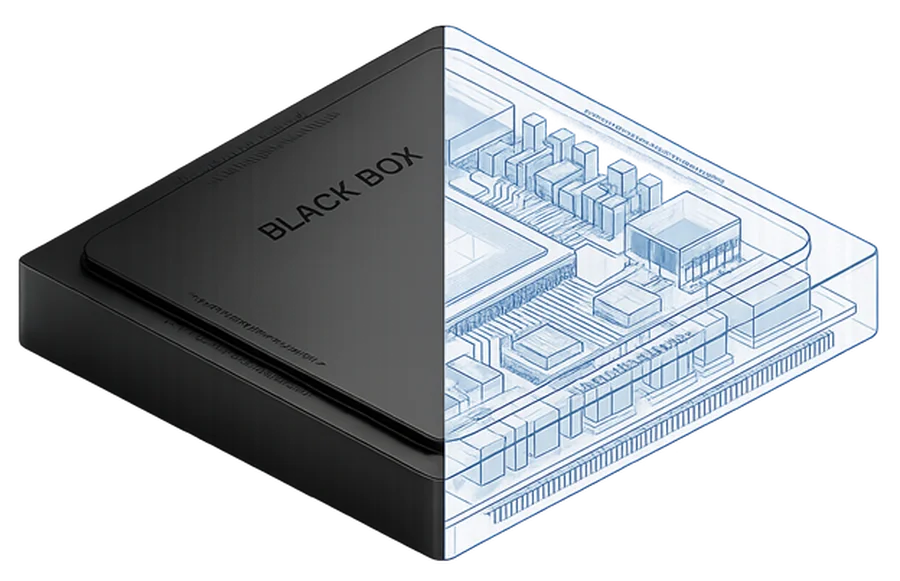
We're expanding across the SoCs powering edge AI.






01 · The Problem
Edge AI is still developed at legacy hardware speed.
Algorithm engineers
Optimizing in Python for their PC, not for their edge device.
Their architecture decisions determine latency, memory, and power on the target chip. But hardware is invisible at design time. Issues that could change every decision surface weeks later, on silicon.
Embedded engineers
Receive code designed without hardware awareness.
Every test and iteration requires a physical dev kit. When the model overshoots latency or memory, they're trapped in flash-debug cycles - each change demanding a hardware round-trip to fix problems that might not even be fixable.
When the mismatch surfaces, the entire cycle resets. Back to redesigning and retraining from scratch - sometimes multiple times per project.
02 · The solution
Enter Ghostlayer. A software layer between your Python and the chip.
Ghostlayer predicts on-device KPIs at design time - so mismatches surface in seconds, not weeks.
03 · Case Study: A Production Edge AI System
8 months to develop a production ready Edge AI system.It shouldn't take that long.
A global technology company needed to deploy a real-time vision model on a constrained commercial SoC. The team spent 8 months trapped in algorithm ⇄ embedded iteration - design, flash, debug, retrain, repeat.
Every mismatch surfaced only on silicon, weeks late, forcing full redesigns. Multiple cycle resets back to the drawing board.
Without Ghostlayer
8 months
Estimated with Ghostlayer
2-4 months
With Ghostlayer: KPI visibility - latency, memory, power - from the first line of Python. Mismatches caught at design time, not after weeks on a board.
Estimated impact based on a historical project experienced
>0%
of development time recovered
40%+
savings on cloud compute
Multiple
full cycle resets avoided
04 · Whole-model validation
Predict latency before deployment.
Ghostlayer analyzes complete ONNX models and estimates their execution latency on target edge hardware - before the deployment cycle begins.
Our predictions are validated against controlled, repeatable measurements on real edge hardware.
Absolute Prediction Error
Distribution of whole-model latency prediction errors
NVIDIA Jetson
0.00 ms
Mean Absolute Error
Average prediction error
0.00 ms
P90 Absolute Error
90% of evaluated predictions fall below this error threshold
<0.0%
Measurement Drift
Mean drift across independent measurement sessions
Latest bounded prospective validation on NVIDIA Jetson hardware. Results describe the evaluated cohort and should not be interpreted as universal performance across arbitrary models or devices.
05 · Why "ghost" layer
We don't change how you work - we sit on top, invisibly.
Ghostlayer sits invisibly on top of your existing workflow - same Python, same compilers, same embedded toolchain, with the hardware visibility you were previously missing.
Drop-in. Invisible. Instantly useful. That's why it's called a ghost layer.
The Vision
Prediction is just the start. Ghostlayer is building toward one-shot optimization.
06 · Built for teams deploying AI on commercial SoCs
A horizontal problem.
Every team building edge AI hits the same hardware wall. We're starting with three industries where the pain is sharp.
Defense
Mission-critical AI on constrained hardware where iteration is measured in months and failure isn't an option.
Robotics
Real-time perception and control on the edge - where every millisecond shapes what the robot can do.
Automotive
Driver monitoring, ADAS, and in-cabin AI on tightly bounded SoCs and multi-year programs.
07 · The team
Built by engineers who lived this problem.
Three technical founders with 20+ years of combined experience building production-grade embedded and AI systems.
Request Early Access
Be the first
to know.
Early access for teams shipping edge AI today. Tell us your role and we'll prioritize seats.